FAQ
About CCS
 source: bp.com
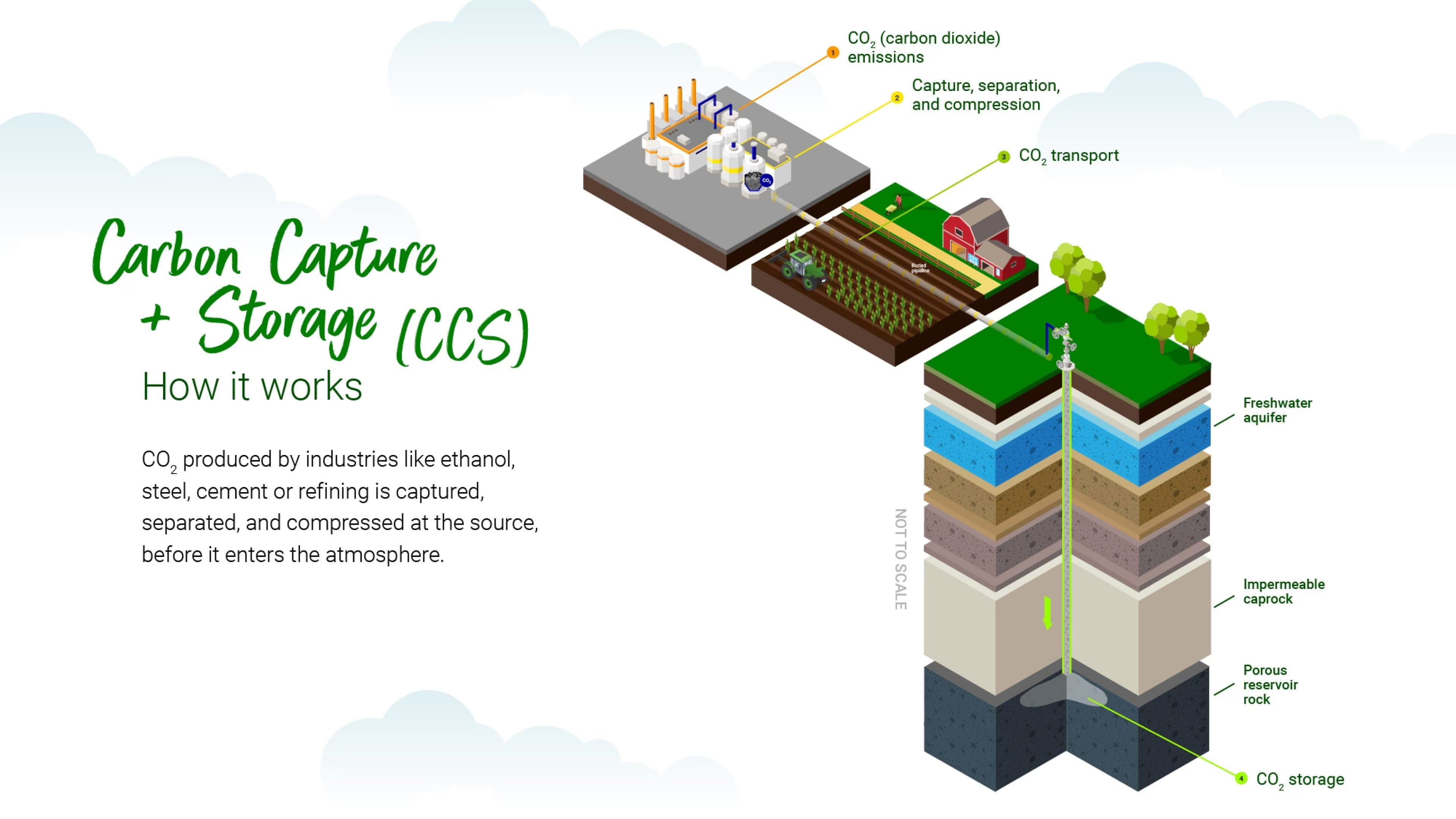
Carbon (Dioxide) Capture and Storage comprises the whole process of capturing emissions on site, their transport and then their storage in safe geologic underground structures.
Most of CO2 emissions are embedded in flows with concentrations of 10 – 20 %. The capture of CO2, therefore, requires rather complex technical solutions and is – at current technology levels - mainly eligible for large emitters. In addition to substantial investments in technology, the capture implies increased energy, mainly electricity consumption.
The captured CO2 then needs to be transported to the storage site, either by pipeline, ship or truck. Transport by pipeline, especially for distances up to 100 km, is by far the most efficient way and will generate only a minimum of additional emissions.
The storage of CO2 requires a porous rock structure which is well isolated from the surface, preferably in depths of at least 800 m. In this environment prevailing high pressures substantially reduce the volume of injected CO2.
Is CCS a good sustainable solution in the EU ?
the straightforward answer is yes.
Several sectors of European key industries depend on fossil fuels or use processes which are economically optimised for the use of fossil fuels.
A transition to other processes or sources of energy based on renewables (and nuclear) will not be feasible on the set timeline and the shifting of emissions to other countries or continents is no viable option.
The availability of sufficient (electrical) energy and its efficient storage, the focus on a wider use of hydrogen (provided sufficient - preferably “excess” – energy and fresh water) in material quantities and the substitution of back-up energy sources required for peak consumption management will also require more than challenging efforts.
CCS is a “simple” solution to reduce, the most efficient where the biggest amounts of CO2 can be reached, in industry and even there the easiest flows, the cheapest to reach may be targeted. And CO2 is one issue, we should not forget about all the Nix’s which are likely to be even more damaging…
Is CCS a safe solution
At this moment a license has been granted to Porthos, an off-shore site in a depleted oil and gas field. The Engas site is a depleted gas field onshore.
In any event the concern is leakage of CO2, from underground and at the surface.
The Engas structure, at a depth of more than 1600m, is proven by many years of gas production, properly isolated by substantial clay and claystone layers and, therefore, impermeable, and safe. The field will permanently be controlled by number of monitoring wells, tracing the underground migration of injected CO2.
On ground technology and pipeline will be equipped with state of the sensor based permanent monitoring systems.
What are economic challenges for CCS
CO2 capture technologies and the availability of a storage site in the vicinity, at pipeline distance.